Wednesday, August 10, 2011

V.S. Gaitonde: Triumph of the solitude

This post is dedicated to the greatest ‘non-objective’ artist from post independence India, Vasudev S. Gaitonde (1924-2001), popularly referred to as just ‘Gaitonde’. His positioning and influence on Indian contemporary art can be compared to that of Agnes Martin, Clyfford Still and Mark Rothko’s. (This is my take on Gaitonde and I don’t think that I’m exaggerating :-) )

It is frequently written about him that he insisted on not being categorized as an ‘abstract’ painter, but a ‘non-objective’ one instead. It is a topic of debate whether non-objectivity is a form to be recognized separately or if it is a subset of abstraction in the broader sense. But in Gaitonde’s context, I think I can understand why he insisted on the differentiation. The answer lies in the modern history of abstract art in India. Abstract painting in India was dominated by gestural figurative abstraction, and the common practice of ornamenting the ideas with ethnic references and cultural motifs. In such times, Gaitonde’s richly evolved forms and luminous colors must have appeared ‘outsiders’ to some, and it is no wonder why Gaitonde himself must have preferred to remain detached from the established school of abstraction.

It was just not only about established practices, but he also remained aloof from people. ‘Gaitonde enjoyed solitude and spent hours philosophizing about art while his beloved Indian classical music or Beethoven or Mozart played in the background’, mentions well-known Indian artist Prabhakar Kolte in his essay about Gaitonde.

Gaitonde graduated from the renowned Sir J.J. School of art of Mumbai in 1948. As a very original and talented young artist, he was invited to join the ‘Progressive artist group of Bombay’, then. Although this influential group was short-lived for various reasons, all the artists from the group created their own successful careers later. Gaitonde chose a path which was different from that of his peers at that time. His interests in linguistics and ancient scripts, his deep study of Japanese Zen philosophy, and his tremendous artistic capacities led him to create his own original understanding and style. His forms are supremely balanced, robust and most importantly they do not carry any forced baggage of the cultural metaphors. Gaitonde’s colors vary from mystic grays to shimmering reds, but they remain in separate peripheries within the painting space. Why I strongly associate his works with Agnes Martin, Clyfford Still and Rothko is for these vary reasons.

When it comes to exploring form, he is more like Agnes, but makes a stronger statement with colors. At the same time he does not seem as keen in exploring interactive possibilities of colors as Rothko. Gaitonde takes a middle path (and here I find a similarity with Clyfford Still) and indulges into form and color relationship. What is common in all these artists is their ability to project coherent relationship of forms, colors and emotions. There they share a same universal platform and create a phenomenal art.

Like his contemporaries mentioned above, Gaitonde had a long lasting impact on the process of understanding the emotional complexity that resides underneath the artistic rendition. Many artists (even today!) tried imitating him, some succeeded in creating lookalike imagery, but none could achieve what Gaitonde did. His innate spiritual temperament and studies of philosophy are also misinterpreted by many by saying that that was a ‘subject’ of his works. Perhaps it sounds more intellectual to quote something around spirituality rather than his painterly process. The fact is that he was an explorer of forms and colors with meditative qualities deep inside. As a technique, Gaitonde used rollers and brushes, and he used oil paints to create multiple layers of varying viscosities, and all of this assimilated on his canvas to bring out a pure experience of sublime quality.

Here ends my post. It should be treated as a brief introduction to this great artist, and needless to say don’t miss his work if you ever get an opportunity. It leaves a lasting impact on the mind!

(Click on the image for the larger view)

Acknowledgment for images: Glenbarra art museum and Saffron Art.

Friday, July 29, 2011

When ‘Red’ takes the center stage


My friend Andrew has posted this very interesting photograph in his recent post. Andrew is an avid traveler and photographer who now lives in beautiful Santiago, Chile. This picture I simply loved for its stark, unambiguous compositional quality and it prompted me to write this quick post.

Take a look at the bright cadmium orange cylinder in the boat. There is a vast body of water, hills and several small boats behind it, but the red color grabs all our attention, not leaving any other possibility for visual expectation. Even as the photographer must have looked at it, the bright cylinder must have demanded the center stage.

Red family of color is a big attention grabber. It demands prominence, and artists obey it many times. It is as if the color will create a major ruckus if not pampered so in the composition. The biggest celebration of this demand is in Matisse’s Red Room and Red Studio. Matisse has left no chance for Red to complaint :-)
Here is a small collection of some beautiful paintings of various artists where Red has graced the center stage.  
Click on the Artist's name to learn more about them.


John Sloan (1871–1951) 'Red Kimono on the Roof' 


Raoul Dufy (1877–1953) 'Three Umbrellas'


Gabriele Münter (1877–1962) 'Village street in winter' 

Amrita Shergill (1913–1941) 'The Storyteller' 

Ben Nicholsen (1894-1982 ) 'Still Life' 

Adolph Gottlieb (1903 -1974) 'Brink'
------------------------------------------------------------------------------------------------------------
Thanks to Andrew for the nice picture and many such amazingly candid snaps that he has taken on the streets and shared in his blog. :-)    

Thursday, July 28, 2011

Mumbai Galleries

Here is some interesting news I think worth sharing, particularly for people staying in Mumbai or visiting over weekends. Many art galleries in Mumbai are generally closed on Sundays and this can be quite inconvenient. But fortunately this is about to change. Last week, I received news that some galleries in Kulaba area of South Mumbai (now almost recognized as an Art district) have decided to remain open on fourth Sunday of every month. Not bad! 

Click for the map

Sunday, July 03, 2011

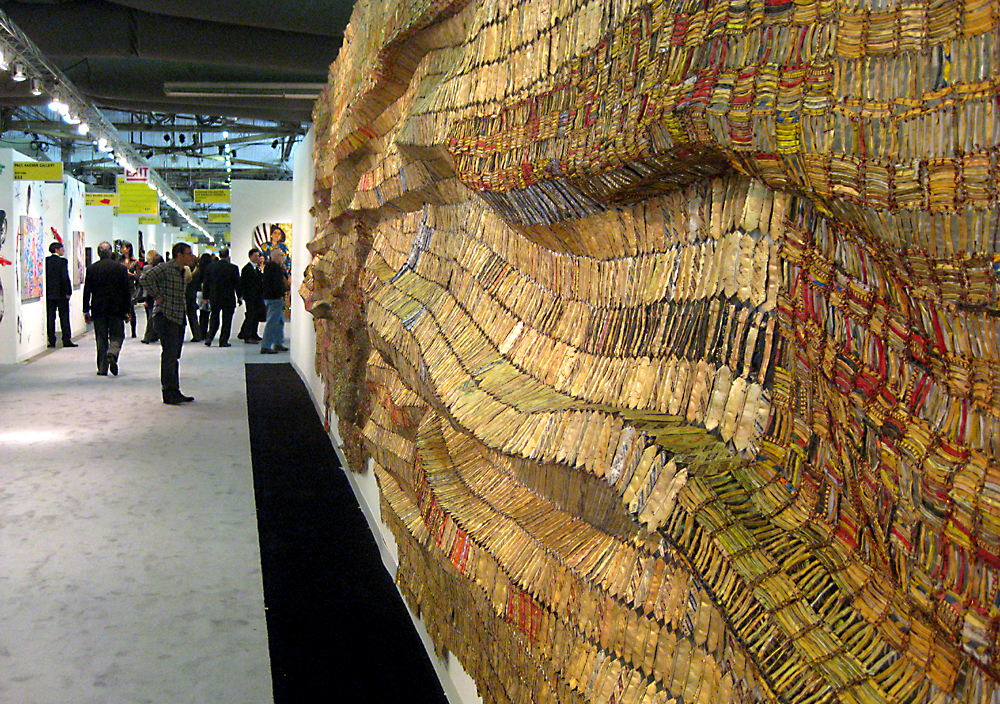
El Anatsui: Shimmering display of the African sensibility

If you are already exposed to the astonishing wall hanging sculptures of El Anatsui, then you will need no further introduction of him. But if not, here is a brief introduction about this legendary Ghanaian sculptor who lives and works in Nigeria. 


Brahim El Anatsui was born in 1944 in Anayko, Ghana. After graduating from Nkrumah University of technology in Ghana, he moved to Nigeria in 1975 to take up a teaching job at Nsukka where he is lecturing at the University’s art institute on sculpture till today. Trained as a sculptor, earlier Anatsui worked with wood, found objects, iron, clay and paint. He established himself and got recognition for his free, unrestricted style of mixed media sculptures. These were non-representational as well as minimal figurative with strong connection with the African symbolism, particularly motifs from Ghanaian culture. Eventually Anatsui’s sculptural quest took him further in his explorations and he experimented with used metal, recycled materials like milk bottles, tins, bottle caps etc. A significant advance came in the late 90’s, when he started creating sparkling tapestry by using flattened liquor bottle caps and beer cans. 


The ‘Anatsui’ that the art world now cherishes and values immensely is through this recent work in particular. Glittering, substantially large in scale and sharply hinting of its African sentiments, Anatsui’s hanging sculptures are free to take any shape and do not display any narrative consciously. But that’s not all about it, behind these magnificent metal hangings there are stories. The stories of conflicting African urbanization, unknown stories of human beings who have touched and used these materials, and also a great attempt to answer some misinterpretations about modern art that has emerged out of African subcontinent form a force behind his work. El Anatsui is praised for his efforts for opening a gateway to contemporary African art, which until now was rather misjudged as mere ethnic native art.
Anatsui’s work has achieved the rare feat of holding on to its innate roots and then going on to transform it into a work of indisputably universal appeal. Today his metal hangings strongly entice the art world and in future, whichever form, shape, and structure they may evolve into, they will always be highly treasured. I strongly feel that his work has created a long lasting impact on the thought process of the art world and a unique place for modern art emerging from Africa. 


Thursday, June 16, 2011

From where Edward Burtynsky stands

“What do you ‘expect’ from a certain artistic expression?” This question may sound weird, at least it sounded to me when I was a student and (over)confident in my tastes. It was a time when any rendering which elicited a full blown explanation of its concept was best received. For example, a play with the depiction of the cutthroat realities of life, a fiction with a definite explanation at the end or a painting with painstakingly achieved photo realism. Fortunately a realization of my narrow perceptions came to me pretty quick, and I refreshed my entire outlook towards art. Now I started expecting more than realism or something beyond realism from any art form. And photography? Where previously I considered it to be only an ‘aid’ painters used to achieve photo realism, now as photo realism in paintings lost its sheen, I reevaluated my views about this form of art. From strident reflections of social concerns to silent spectators of unseen worlds, pictures are certainly playing a vital role in my overall understanding of imagery in the process of creating art.


I like Ansel Adams’ quote which says “A good photograph is knowing where to stand”. Accomplished Canadian photographer Edward Burtynsky not only knows where to stand but also knows when to stand :)


Marble stone quarries, mines, railroads that cross obscure terrains or mass production factories in China, autobahns, heaps of used tires, ship breaking yards of Bangladesh – Burtynsky goes to these worlds that are sometimes unknown, unseen or even inconvenient to project. His pictures which sometimes appear quiet, at other times appear like frontline protestors. His photographs are like non objective compositions which take you along on a mind boggling voyage of the two dimensions. 


It is not that I do not approve of photo realistic painters, but when I see photography like that of Edward Burtynsky’s, I wonder what it is that painters are trying to achieve by recreating in paint, that which photographers have already captured with great spontaneity and poignancy.


My Sincere thanks to Edward Burtynsky and Marcus Schubert from the office of Edward Burtynsky for permissions.